
Quick answer: The Semrush Keyword Magic Tool turns one seed keyword into grouped keyword ideas with volume, difficulty and CPC.
It suits anyone planning content or PPC who wants to find and filter long-tail keywords fast.
Semrush sometimes offers free trials of its paid plans, so check its website for the current offer before you sign up.

One thing that Semrush has always done really well is keyword research. The data that they provide is usually pretty extensive making the process of keyword research much easier.
This is even further improved with the Keyword Magic Tool. This is a tool that gives you plenty of suggestions and ideas when it comes to keyword research.
YouTube video paused
Allow YouTube to load videos and use cookies or similar storage. Google receives connection information and may process it under its privacy policy.
Privacy policy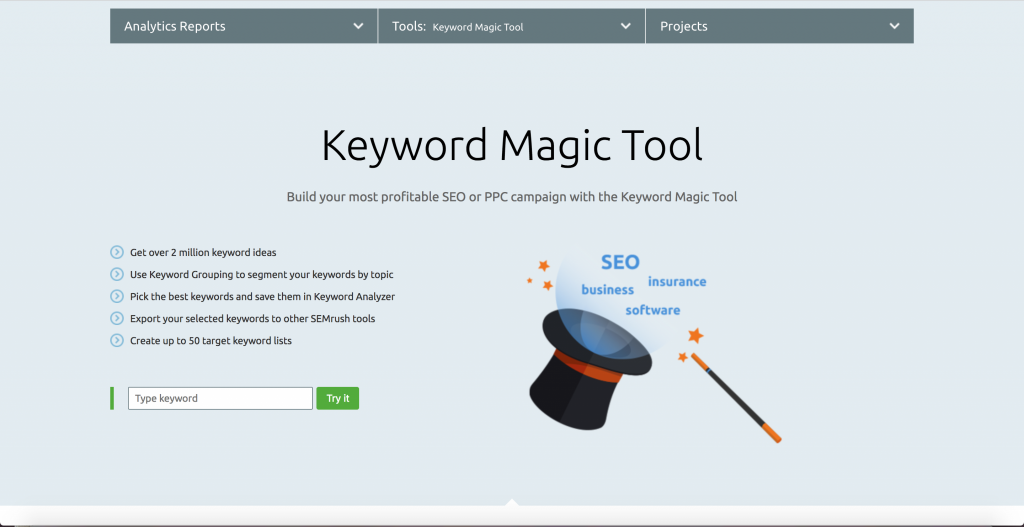
How to use the Keyword Magic Tool
The tool itself is actually pretty easy to use. To get started all you need to do is enter any keyword, and Semrush will pull up loads and loads of different suggestions.
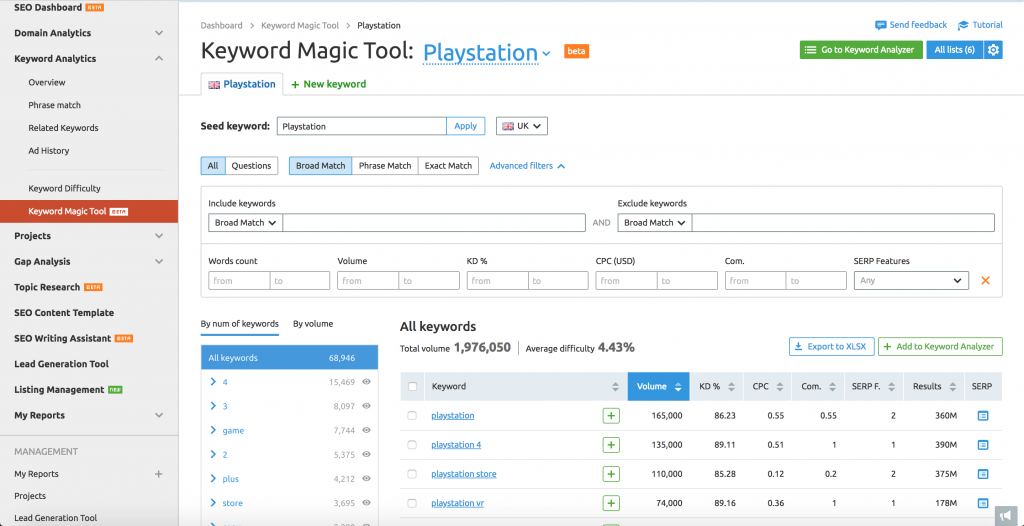
In this example, I’ve just used the keyword “Playstation”. Above is the page that shows once you’ve entered your search term, At the top of the page there is your ‘seed keyword’, this is the main keyword you started with.
Filters worth using
Then you have all of the filtering options for your keyword, these can be broken down into Broad match, phrase match and exact match.
Underneath this you have all of the suggested keywords, you’ll also notice a total volume search and an average difficulty rating. This is compiled data from all of the keywords which gives you an insight into your main keyword overall.
Keyword groups and categories
One thing you’ll see on the left-hand side is a list of categories and subcategories.
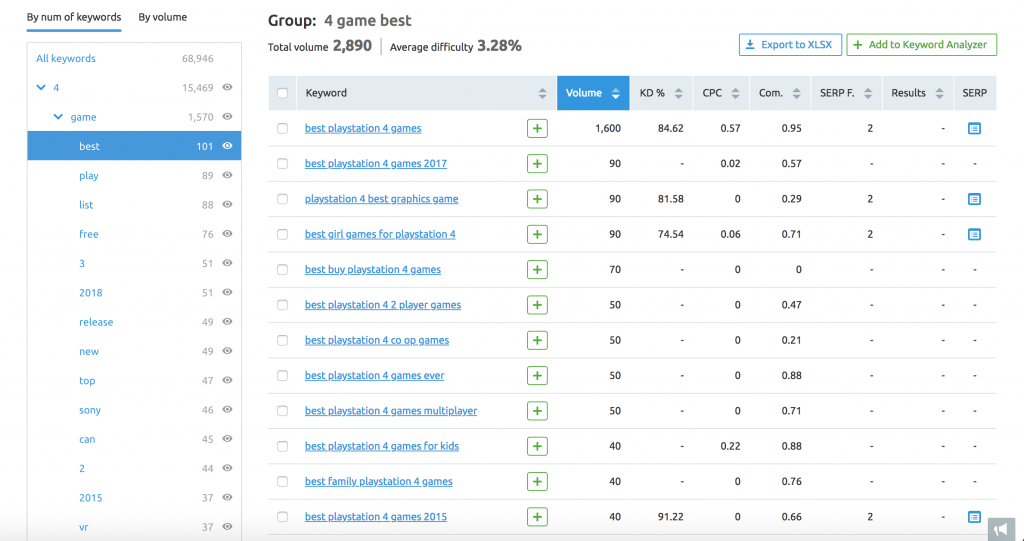
This splits all of the suggested keywords up to help you organise them. So with the keyword “PlayStation” there are loads of different categories relating to this such as “store”, “4”, Sony” etc. Then as you go further which I have done with the “4” category here, you’ll see a whole new list of subcategories.
Depending on how popular your keyword is, the more categories there will be. As you know PlayStation is a widely know gaming console that has lots and lots of variations.
I’ve broken my way down to a list with the keywords “4”, “games” and “best”. The keywords on the right-hand side now reflect now all contain those words within them. You can also see the total volume and difficulty for these words as well.
To track where your brand is mentioned online, see my guide to Semrush Brand Monitoring.
The metrics explained
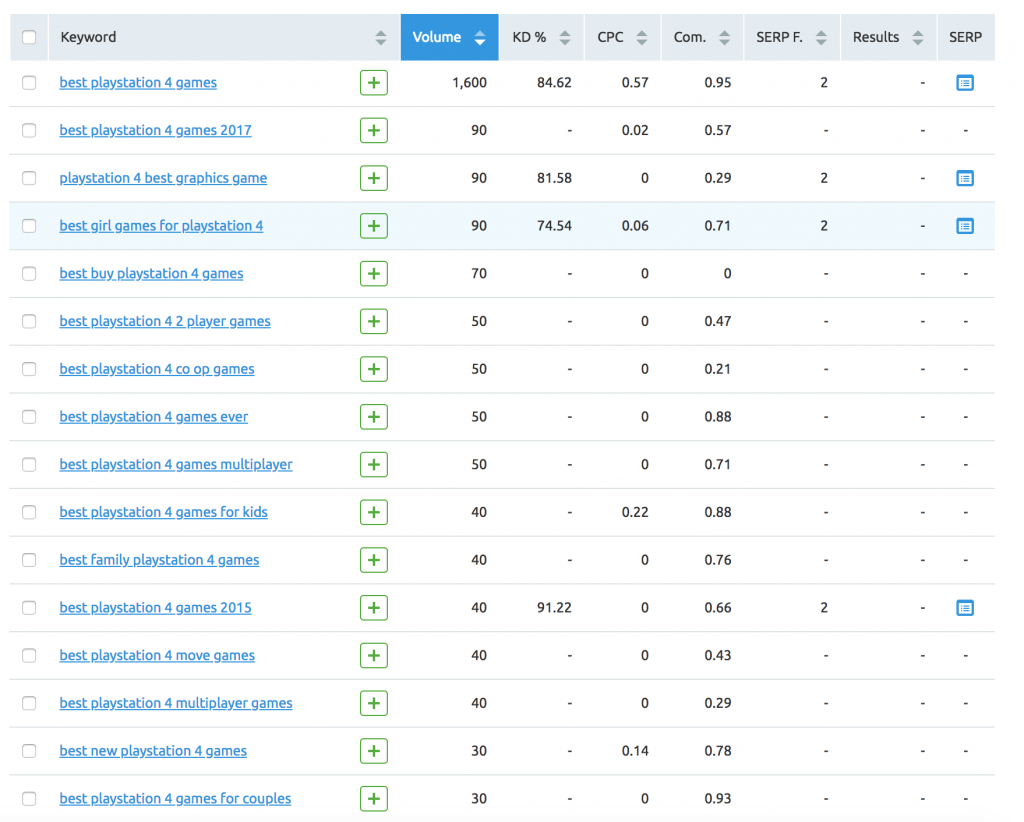
If we take a closer look at these keywords now you can see the metrics Semrush provides.
Volume – This is the number of people that search for the keyword per month.
Keyword Difficulty (KD) – This is a rating from 1% to 100% in terms of how difficult Semrush estimate it is to rank for the keyword.
Cost Per Click (CPC) – This is the average cost per click in US dollars if you were bidding on the keyword in Google Ads.
Com. – This is a rating from 0.00 to 1.00 based on how much competition on PPC there is for the given keyword.
SERP F. – This is the number of features that show in the SERPs. This is typically things like rich snippets etc.
Results – This is the number of results that show up on google for that specific keyword.
SERP – Clicking on this will bring up the results page on Google.
As with the keywords above, the more refined your categories become the fewer stats will appear. If results are missing some stats it’s due to the fact the keyword itself isn’t too widely searched and Semrush haven’t got fully round to providing the data for it.
Keyword Analyzer
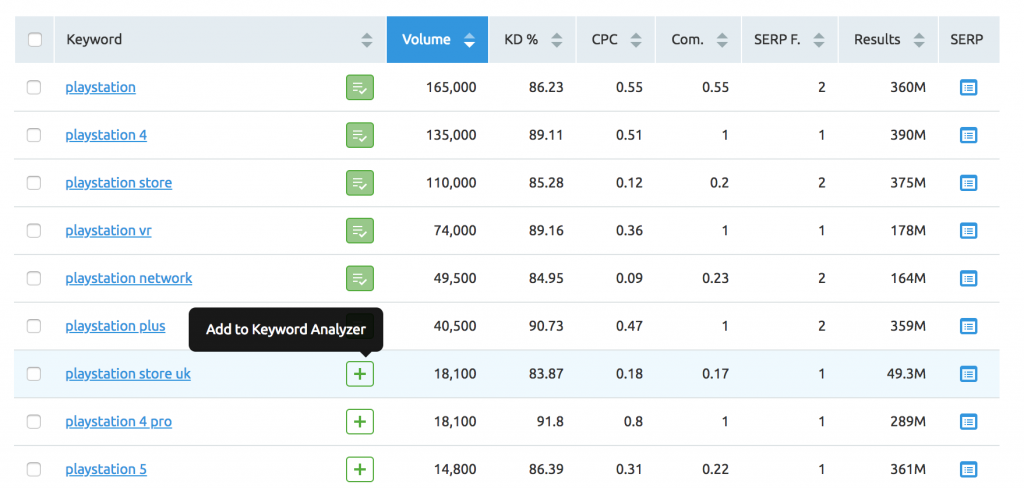
You’ll also notice there is a little box with a “+” inside it beside each keyword, this allows you to add any of the keywords into the keyword analyser.
Once you’ve added them to this you can then see a bit more information about each of the keywords.
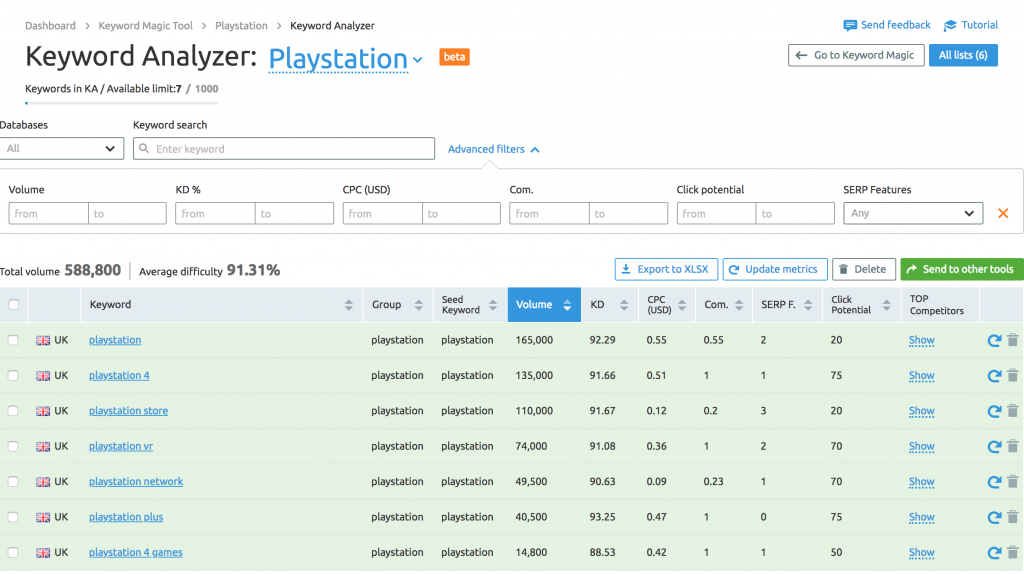
At the end of each word, there are two new stats for you to look at. Click potential and TOP Competitors.
The first is a percentage score as to how likely it is these keywords will be clicked on and the top competitors gives you the list of the first results in google for each keyword.
Exporting

In the top right-hand corner, there is the option to do even more with this data. The “Send to other tools” button lets you take all of the keywords in your analyzer and set up them up in position tracking and the Semrush PPC tool.
The option is also there to export the data in excel format.
Summary
Semrush updates its tools regularly, so check the Semrush website for the Keyword Magic Tool’s current status and features. When it comes to keyword research it can be hard to get good ideas together for writing content and understanding what the public actually search for. Semrush‘s keyword magic tool is definitely a useful tool to help solve these problems. With its in-depth research and filtering system you will be able to organise a good list of keywords to start targeting in no time.
For quick checks while browsing search results, see the SEOquake review, a free extension from Semrush.
If you turn your keyword research into video content or live streams, my StreamYard review covers the tool I use to go live.