A written adaptation of Craig’s Guide to Internal Linking for SEO, Importance of Internal Linking (8 November 2020). A practical follow-up to the Semrush keyword research guide.
YouTube video paused
Allow YouTube to load videos and use cookies or similar storage. Google receives connection information and may process it under its privacy policy.
Privacy policyThis focused six-minute tutorial connects supporting articles to a main guide, explains crawlability and recommends natural anchor text. It suits readers who have a keyword shortlist but need to turn it into a connected set of pages.
What Craig covers
Craig uses an affiliate-marketing guide as his main page, with supporting articles linking back to it. He discusses auditing internal links and avoiding repetitive, spammy anchors. He credits Andy Drinkwater’s internal-linking guide; the chart mentioned in the video is not Craig’s own test.
Source and evidence boundary
The available public transcript and video metadata were checked on 9 November 2026. The transcript appears automatically generated; no word-for-word quotations or timestamps are used. The steps below are an editorial expansion, not a claim that Craig demonstrated these exact examples. Google’s public documentation was checked separately.
Screenshots in this guide are genuine captures of Craig’s current preview site and Google’s public guidance, taken on 9 November 2026. They are not frames from the 2020 video, account results or evidence of ranking gains. This adaptation preserves the original article address and publication date.
Source video: youtube.com/watch?v=26OlO7qEg7o
1. Choose the main page, then map support
Start with the page a reader should reach to complete the task. Supporting pages should add depth rather than repeat it. A hub is a useful resource, not just a list of keywords or a page chosen because it is the oldest.
Worked example A — Craig’s existing Semrush content
The main resource is /semrush-keyword-research/. The Topic Research article explains idea discovery; the Organic Research article explains competitor investigation. Both provide a relevant route into the keyword-shortlisting workflow. These are real existing addresses, not invented pages.
A compact link map
Tool Reviews collection → keyword research guide
Discovery: readers browsing research tools can find the guide.
Topic Research → keyword research guide
Next task: turn topic ideas into candidate search queries.
Organic Research → keyword research guide
Next task: assess competitor queries for the business’s own shortlist.
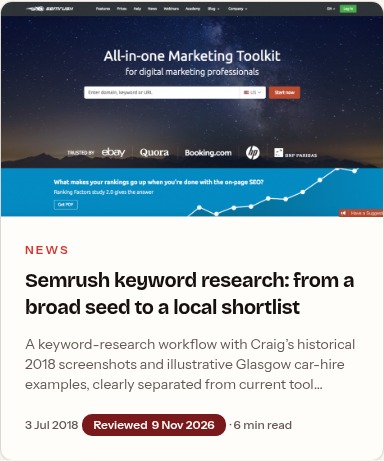
Screenshot 1 — genuine Semrush guide card in the Tool Reviews collection, captured from Craig’s preview on 9 November 2026. Original publication date remains 3 July 2018; the Reviewed date is separate. This is navigation evidence, not search-performance evidence.
Keep historical addresses and dates
Adding an internal link does not require renaming either article or changing its publication date. Preserve the original address; use a separate review date only when a substantive content review has actually been completed.
2. Write the link in a useful sentence
The reader should be able to predict what opens next. Choose concise, descriptive words that fit the sentence. Do not force exact-match keywords into every link or add arbitrary anchor-percentage targets.

Screenshot 2 — a real contextual link added to the existing Organic Research article in Craig’s preview, captured 9 November 2026. It leads to the original /semrush-keyword-research/ address. No rankings or traffic results are implied.
Worked example B — fictional Glasgow car-hire site
Assume a fictional business genuinely serves Glasgow airport customers. The following are planning examples on example.com, not client work, measured search demand or existing Craig pages.
Source: /guides/airport-collection/
Destination: /car-hire-glasgow-airport/
Suggested sentence: “For collection options and availability, see our Glasgow airport car hire page.”
Why: it moves a reader from practical collection advice to the relevant service.
Source: /guides/driving-in-glasgow/
Destination: /car-hire-glasgow/
Suggested sentence: “Planning a trip without your own vehicle? Compare our car hire in Glasgow options.”
Why: include it only where hiring a vehicle genuinely helps the reader.
Reject: a link from airport collection advice to an unrelated service just because that service needs links. Also reject a promise of airport collection if the fictional company does not provide it.
Practical checks before adding it
Open the source and read the paragraph. Confirm the destination answers the next question, the link is not already present in that context, and the anchor is clear without cramming extra keywords. Use a normal link with an href; a script-only click target is not a substitute.
3. Check, record and review
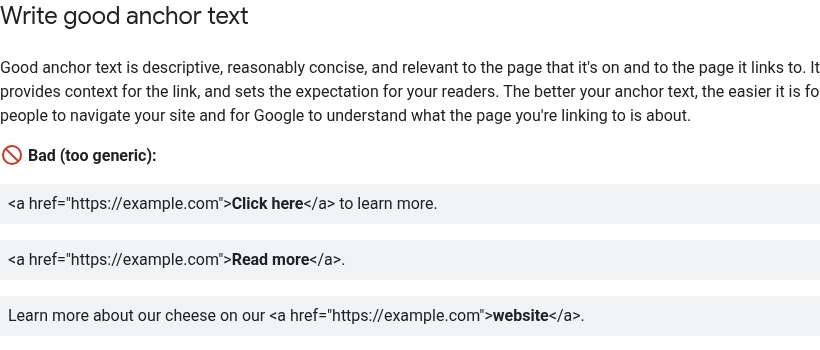
Screenshot 3 — Google Search Central’s “Write good anchor text” guidance, captured 9 November 2026. Public documentation, not a screenshot of a crawl or firsthand tool testing.
Before and after checklist
Before: record source, destination, proposed anchor and the reader’s next task. Confirm the target loads, is the intended address and is meant to be indexable. For larger sites, use a crawler to review discovered links and inspect the page itself.
After: click the link on a phone and desktop. Check that it reaches the intended page directly. Record the change date and recheck the page or crawl. Review search and enquiry trends over comparable periods, but do not attribute every change to these links.
Limitations — avoid turning advice into promises
Internal links help discovery and context; they do not guarantee indexing, rankings or enquiries. A crawl only covers what its configuration discovers: it cannot prove there are no orphan pages. Compare against a known URL inventory when auditing. Categories are not hard linking boundaries; useful cross-topic links can make sense. There is no universal number of links to add, and varying wording mechanically is not the goal.
Sources and provenance
1. Craig’s original video and available transcript — public metadata lists 8 November 2020, 6:10; checked 9 November 2026.
2. Google Search Central: Link best practices — checked 9 November 2026.
3. Andy Drinkwater guide credited by Craig — attribution from the video; not independently checked for this guide.
Explore the Tool Reviews collection, Topic Research article and Organic Research article alongside the worked example.