I use AI as a working tool, not as an excuse to stop thinking. It can help organise notes, explore an outline and produce a rough draft, but the publisher remains responsible for every instruction and factual claim. The useful question is not whether a tool can generate an article quickly. It is whether your process can turn that output into something accurate, original enough to be worth publishing and genuinely helpful to the reader. Here is the workflow I would put in place before increasing production.
Quick answer: use AI to assist, not approve
A safe AI content workflow separates preparation, generation, verification and publication. I define the reader’s problem, gather suitable evidence and write a brief before asking a model for any draft. Then a human editor checks the reasoning, a responsible person verifies consequential facts and the publisher approves the final page. The model can help organise material, but it does not take responsibility for what you publish.
The key control is traceability. Important claims should lead back to a source somebody actually inspected, not a plausible-looking citation generated alongside the sentence. If a statement cannot be checked, remove it, narrow it or mark it as unresolved in the internal draft. Do not turn uncertainty into confident copy simply because the paragraph reads well.
This approach is useful whether you draft a complete article or use a model only for outlines and summaries. The amount of generated text is not the only risk. A single invented specification, quotation or safety instruction can matter more than several pages of ordinary background explanation.
Step 1: define the task and its boundaries
Start by describing the audience, the decision they need to make and the information the page must provide. Decide whether a new page is needed at all. If an existing article already answers the question, improving it may be more useful than producing another near-duplicate URL. Content production should follow a publishing need, not an available generation quota.
Classify the risk. Advice involving health, finance, law, security or physical safety requires appropriate specialist involvement. A general editor should not approve such advice just because it sounds cautious. Decide which topics are outside the workflow and which require a named professional to assess the actual final wording.
Set data rules before using a service. Do not paste customer records, confidential contracts, credentials or unpublished commercial information into a tool without the necessary permission and an assessment of its current terms and controls. Product settings and retention arrangements change, so verify the arrangement your organisation actually uses.
Assign roles even in a small team. One person may wear several hats, but the draft still needs separate passes for substance, evidence and presentation. Record who can stop publication when something cannot be verified. A workflow with a deadline but no authority to reject weak material is not much of a safeguard.
Step 2: build a source pack before drafting
Collect the primary material the article needs: official documentation, relevant standards, product information, your own recorded observations and properly attributed expert input. For every source, note the URL or internal location, the date checked and which claims it supports. Save enough context to avoid quoting a sentence in a way the source does not justify.
Prefer the original source for consequential factual claims. A competitor’s article may help identify questions, but it should not become the hidden foundation for your own piece. Trace a statistic or technical claim to its origin and check the methodology or scope where relevant. If you cannot establish the origin, you may not need the claim.
Separate evidence from examples. An illustrative example can explain a process without pretending a client achieved a particular result. Label it clearly and avoid invented performance figures. Similarly, do not ask the model to add personal experience in your voice unless you have supplied a genuine account that you are willing to publish.
Keep a list of unresolved questions. Missing information is useful editorial feedback: it tells you where research or specialist input is needed. Filling every gap with fluent background text hides those problems and makes the later review harder. I prefer a draft with visible research notes to one that disguises uncertainty.
Step 3: create a brief that constrains the draft
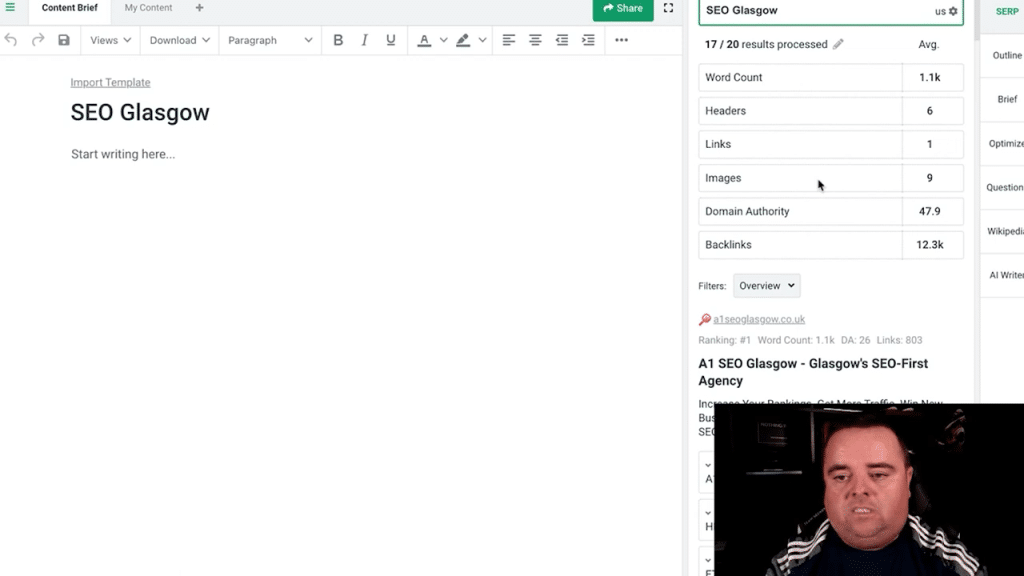
The brief should specify search intent, the main answer, the intended reader and the scope. Include required questions, useful examples, the evidence pack and the points the article must not claim. Tell the writer or model what existing pages should be linked and where the new page differs from them.
My content brief guide covers the wider planning process. For AI-assisted drafting, I add explicit rules against invented sources, quotations, statistics, credentials and first-person experiences. I also require uncertainty to remain visible in the working draft rather than being silently resolved by the model.
Ask for a proposed structure before a full article. Review whether the sections follow the reader’s task, whether essential limitations appear early enough and whether a table or checklist would genuinely help. An outline that simply mirrors the current search results is not yet an editorial plan.
Use a short acceptance statement: after reading, the person should be able to complete a defined task or make a better-informed decision. This gives the editor something concrete to test. Word count can guide scope, but it cannot prove that the explanation works.
Step 4: draft in controlled stages
Work section by section when the subject is complex. Supply the relevant evidence and ask for a focused explanation with unresolved points clearly identified. Smaller units are easier to compare against sources, and you can stop a mistaken interpretation before it spreads through the entire article.
For an illustrative example, a software tutorial might begin with prerequisites and a reversible test. Draft those first, verify them in the relevant interface and only then explain the wider process. Do not let a generated sequence become the instruction set without checking that the controls and terminology actually exist.
Treat model output as untrusted working material. It may merge two sources, omit a qualification or express an inference as a fact. Asking it to review itself can produce useful questions, but it is not independent verification. Agreement between two generated responses is not evidence that either one is correct.
Keep the author’s voice grounded in real contributions. I can make an explanation plain and direct without claiming I personally tested something I have not tested. Remove stock introductions, repeated summaries and generic enthusiasm. The aim is usable instruction, not a polished imitation of expertise.
Step 5: fact-check claims one by one
I separate factual verification from copy editing. Otherwise it is easy to fix punctuation while missing that a central claim has no support. Create a claim register for the parts that could affect a reader’s decision.
| Item | Verification method | Action if unresolved |
|---|---|---|
| Product capability | Check current official documentation and relevant access | Narrow or remove the claim |
| Statistic | Inspect the original source and context | Omit rather than invent |
| Quotation | Compare with a recording or original publication | Remove unsupported wording |
| Practical instruction | Test safely or obtain qualified review | Do not publish as verified |
| Personal experience | Confirm with the named contributor | Rewrite without the claim |
Open every cited source yourself. Check that it exists, says what the text implies and applies to the relevant date, geography and version. A source can be genuine but unsuitable. A historical feature announcement, for example, does not prove the same interface or entitlement is available to every account now.
Inspect numbers and comparisons carefully. Check units, dates, arithmetic and whether the comparison uses equivalent conditions. Avoid vague claims such as “the best” unless you define a defensible basis. Many articles become more useful when unsupported rankings and decorative statistics are removed.
For changing information, explain the condition rather than pretending permanence. If a process depends on account permissions, say so. If you cannot verify a current feature, describe the general task or leave the detail out. Precision includes being honest about what you do not know.
Step 6: edit for reasoning and practical usefulness
Read the draft as someone trying to do the job. Are prerequisites visible? Does each step tell the reader what to inspect and what result to expect? Have you explained what to do if the result differs? A sequence can be grammatically clean and still fail as a tutorial.
Add real value from people who understand the subject: a useful diagnostic distinction, a limitation, a worked example or an explanation of why one option is safer. Do not add anecdotes merely to make the piece seem human. The contribution should improve the decision or instruction.
Use an answer-first structure where it suits the question. Give the main answer promptly, then supply conditions, evidence and detail. Avoid burying important caveats at the end after the reader may already have acted on an oversimplified instruction.
Check originality in substance, not just wording. A rearranged summary of existing articles may add very little. Ask what this page contributes for its particular audience. If you cannot identify a useful contribution, revisit the brief instead of spending more time making the sentences sound distinctive.
Step 7: approve, publish and monitor
The final approver should see the actual publishable version, including headings, tables, links and disclosures. Last-minute edits can introduce new claims after the evidence review. If a significant statement changes, return it to the relevant reviewer rather than assuming the previous approval covers it.
Check the rendered page on a representative device. Test links and navigation, confirm the correct author information and verify that draft notes or unresolved placeholders have not leaked into the public page. Ensure any structured information matches the visible content rather than an earlier draft.
Record the publication date, evidence review date and person responsible for maintenance. For a changing topic, set a review trigger such as a product update or regulatory change. A calendar reminder is helpful, but event-based review often catches problems sooner.
Monitor questions, correction requests and whether the page helps visitors reach the intended next step. Search visibility is useful feedback, but it should not override a known accuracy problem. My guide to refreshing existing content explains how I fold those findings back into maintenance.
A practical review handover
Send reviewers the brief, the source pack and the questions that remain unresolved, not just a polished document with a request to approve it. Explain which claims need their particular expertise. A specialist can give a more useful review when the scope is explicit and they are not expected to reconstruct the research from scratch.
Keep a simple change log during approval. If an editor changes the strength of a recommendation, the applicable conditions or a numerical value, flag that for renewed checking. Small wording changes can alter meaning substantially. Approval belongs to a version of the content, not an unlimited series of future rewrites.
When a review fails, record the cause. Perhaps the source pack was weak, the brief encouraged unsupported comparisons or the tool filled missing details too confidently. Fixing that upstream cause is more valuable than correcting the same error in every article. The workflow should improve as the team learns where mistakes occur.
Safe AI publishing checklist
Run this in order before publication. A failure at an early stage is a reason to revisit the work, not a box to tick with a vague assurance that somebody probably checked it.
- Confirm that the page serves a real need and is not an unnecessary duplicate.
- Define risk, responsibility and the subjects requiring specialist input.
- Remove confidential or unnecessary personal data from tool inputs.
- Create a source pack and list unresolved questions.
- Approve the brief and structure before expanding the draft.
- Check consequential facts against sources somebody actually inspected.
- Test instructions safely and document meaningful limitations.
- Edit for a complete answer, clear reasoning and genuine usefulness.
- Approve the final rendered version with accurate attribution.
- Assign maintenance and a monitored correction route.
Keep lightweight records rather than building bureaucracy nobody follows. A brief, a source list and a clear approval note may be enough for a straightforward article. More consequential subjects need stronger controls. The process should match the risk while remaining practical enough to use consistently.
Common AI content workflow mistakes
The biggest mistake is asking for a finished article and treating the review as a quick read for tone. Fluent text can conceal invented details and weak reasoning. If you have no evidence pack and no subject knowledge, you may not know what to challenge. Start with the evidence, not the paragraph count.
Another mistake is confusing detection with quality control. A tool’s guess about how text was produced does not establish whether the advice is accurate or useful. Assess the actual content, its sources and its contribution. Likewise, rewriting generated text does not automatically fix an underlying factual error.
Finally, avoid scaling before the process works. Publishing more drafts multiplies unresolved issues and maintenance obligations. Test the workflow on a small, representative batch, inspect where reviewers struggle and adjust the brief or ownership. Throughput matters only after you can repeatedly produce something worth publishing.
Frequently asked questions
Can AI-written content rank in search?
Content should be judged by its usefulness, accuracy and compliance with relevant search policies, not by assuming a production method guarantees success. Automation used mainly to generate large amounts of low-value material creates a different proposition from a carefully researched page. I would not promise rankings based on either human or automated authorship.
Do I need to disclose every use of AI?
Follow applicable rules and be transparent where the method materially affects what readers should understand or reasonably expect. Internal assistance with an outline is different from presenting generated material as a real experiment. Never imply personal testing, expert approval or original reporting that did not happen.
Can a second model handle fact-checking?
It can help flag questions, but it should not be the only check. Models can share errors and may agree confidently without evidence. Verify important claims against suitable sources and involve qualified people where necessary. The check needs a reliable basis outside the generated answer itself.
What should I do with unsupported claims?
Remove them, narrow them to what you can establish or leave them unresolved in the internal draft pending research. Do not publish an unsupported statement just because it sounds plausible. Often the article becomes clearer when a decorative statistic or sweeping comparison disappears.
How much should a human editor change?
There is no useful percentage target. Some drafts need complete restructuring; others need limited wording changes but extensive verification. Judge the final page against the brief, evidence and reader task. The amount of rewriting is not proof of quality or of a safe process.
If you want help building a workable publishing process rather than simply producing more drafts, contact me with your current workflow and the problems you need to solve.